
Lead-Gen now on Auto-Pilot withBuild My Campaign
Valasys Media — Empowering marketers with powerful insights

How Customer Experience Management become Smarter in 2020

Customer Experience Management will be smarter in 2020 as the marketers embrace digitization, harness customer data & analyze it for valuable insights.

Valasys Media
Valasys Media
Last updated on: Apr 8, 2026
Customer-Experience-Management
Customer Experience Management (CXM) is a new visionary approach to marketing & it’s about architecting a favorable environment for enhanced customer experience (CX). Customer Experience Management is all set to become smarter in the year 2020. The marketers keeping pace with digital transformation will harness mountains of customer data from diverse platforms across the web, as well as from the physical channels & will put them to use for extracting valuable insights from data analysis & interpretation. In an era of omnichannel marketing, marketers need to connect to customers at every touchpoint, analyze their multi-intent & accordingly, need to work out ways to deliver customer expectations. Customer Experience Management (CXM) is an absolute imperative for B2B marketers to get a competitive edge in the year 2020 & beyond. According to Gartner, over 80% of the organizations expect to compete mainly based on CX this year. Evidently, focusing on CXM is essential for a company’s future success. Having a stringent Customer Experience Management (CXM) framework not only helps marketers with customer acquisition & optimized sales conversions but also helps in client retention & omnichannel reputation management & branding endeavors. According to Gartner Customer Experience Management (CXM) is the practice of designing & reacting to customer interactions to meet or exceed their expectations, leading to greater customer satisfaction, loyalty & advocacy. Customer experience is the summation of both conscious & subconscious perception of customers of explicit & implicit emotions that they have about a brand – resulting in interactions with your brand during the customer life cycle. Customer experience management (CXM) is about serving online customers by understanding & prioritizing their expectations. Understanding your customers well & delivering personalized experiences inspires customer loyalty & evangelizes others about your brands via positive Word-of-Mouth-Marketing (WOMM). Read more on 8 Reasons why B2B Marketers Should Prioritize Word of Mouth Marketing (WOMM) Why Customer Experience Management is Important With the evolution in the field of B2B marketing, customers have become more powerful than ever before. As the research methodologies of the customers have evolved, it has led to a marketing paradigm shift from a product-focused approach to a customer-focused approach. Marketers need to create new opportunities for customer success. This, in simple words, means that customers should get the answers to the questions that they’re seeking at the right time & at the right platform. They must be able to figure-out clearly whether the answer to their question lies with a particular product or service at scale. According to Forrester, experience-led companies have 1.6x higher brand awareness, 1.5x higher employee satisfaction, and 1.9x times higher average order value.  Moreover, businesses driven by experience have 1.7x higher customer retention & 1.6x higher customer satisfaction rates. At a time when digital transformation is spurring across many of the B2B organizations, the brands need to prioritize Customer Experience Management (CXM) to collect truly relevant customer information to drive revenue growth. Analyzing the intent data of the customers from the first & third-party sources gives marketers an idea to collect truly relevant customer information & implement the data-driven customer insights to make wiser business decisions. Collecting relevant customer information helps the marketers in devising impeccable strategies for optimizing their core marketing endeavors & for formulating winning strategies for achieving revenue goals. Marketers also need to qualitatively & quantitatively access their CX indexes. Assigning core metrics related to CX & aligning them the core business KPIs, assures that the brands are well-positioned to measuring & optimizing their CX endeavors. Customer-centricity isn’t a new concept for the brands & with the evolution of the MarTech technologies, excelling at Customer Experience Management (CXM) provides brands a critical advantage over their competitors in terms of acquiring a bigger chunk of marketing share & can provide tangible business value. Devising an optimized Customer Experience Management architecture benefits the marketers in the following ways:
  • Providing hyper-personalized & individualized experiences to the prospects and customers at the right time & the right place assures that the multi-intent of the customers is prioritized. This ensures that the customers’ experience is optimized leading to optimized conversions.
  • As the brand performance strengthens through differentiated experiences not only the sales revenue bolsters but the positive Word-of-Mouth-Marketing (WOMM) also helps in building positive brand resonance
  • Improve customer loyalty & create advocates through valued and collaborative sessions with the customers
  • As the customer churn is reduced, costs of customer acquisition are lowered
Evolving trends of Customer Experience Management in 2020 Customer Experience Management (CXM) is increasingly becoming driven by technology. Leading technology companies across the globe are embracing the fact that implementing the latest technological developments have helped their companies grow their footprints in providing exceptional customer experience across omnichannel. Technology has become a decisive factor for companies of all sizes to sustain in their marketplace & outlast their competitors. Data lies at the center of all the CXM endeavors that the enterprises make. To access & analyze the multi-intent of the customers, the marketers need to collect as many data-points about the customers as possible. Based on the analysis of the intent data of the customers, at various stages of their buying cycles, marketers can think of ways to optimize the graphs of their customer experience (CX). With the whole of 2020 ahead of us, marketers need to think of ways to enhance their reach to customers’ data & come up with new ways to precisely segment their audience groups. The more refined the segments, the better is the targeting, the greater is the customer experience & the higher is the probability of optimized sales revenues. With data fueling almost every big bet in the B2B dominion including Customer Experience Management (CXM), the following are the emerging trends in B2B customer experience management that the B2B marketers can look forward to matching pace & ballet with:

1. Employing Artificial Intelligence (AI) & Machine Learning (ML) to Understand Your Customers:

Artificial Intelligence (AI) is an enabler of customer experience management (CXM) strategies. AI along with machine learning can influence every aspect of any organization. We have already seen the impact of AI on every aspect of an organization including customer interaction management. Micro-targeting & customer segmentation strategies are already being enhanced by Machine Learning Algorithms. As the segments of customers are refined to suit niche marketing by leveraging ML algorithms such as k-means clustering, the right messages can be sent to the right customers at the right time which helps in elevating the CXM index. Improvement in AI & the ML algorithms has largely made the search results on the search engines intent-based rather than being keyword centric, a process which continues in 2020 with the evolution of the Google’s core search algorithm after the January 2020 core update. Businesses can apply data cleansing, analysis, interpretation & learning algorithms to get a sneak-peek of customers’ behaviors & research methodologies across omnichannel, their desires, as well as their expectations. According to a report by IDC, 65% of the customers are expected to extend the pursuit of their physical & digital experiences using voice search, images & implying augmented reality to interact with brands on their mobile devices by the year 2023. The same research predicted that by the end of the year 2020, 25% of international brands will contract with AI & human translation platforms to provide a multichannel localization and contextually relevant personalized experiences. The IDC analysts have also predicted the customer experience technology market to total over $600 billion by 2022.  Thus, artificial intelligence (AI), backed by groundbreaking technologies lies at the core of revolutionizing Customer Experience Management.

2. People-centricity will take Centre Stage in driving Customer Experience Management (CXM) & Silos Marketing Endeavors will be a thing of the past: 

According to Gartner, 70% of enterprises will experiment with immersive technologies to be used by the customers as well as enterprises & 25% will deploy them for production by the year 2022. Leveraging the intelligence of the integrated technologies the customers will be able to develop holistic customer experience management (CXM) platforms. The multi-touchpoint aspect of experience will connect people across an array of devices – be they traditional computing devices, wearables, automobiles or environmental sensors. Brands can try prioritizing CSR (corporate social responsibility) activities. This assures that brands reflect on their pledge to contribute to society. This, in turn, enhances customers’ experiences. Equally important for brands is prioritizing employee experience. According to Harvard Business Review, companies that invest in employee experience are 4.2x more profitable than those that don’t. The social, environmental or political factors within a company influence the realm of Customer Experience Management (CXM). Companies can perform market analysis such as SWOT & PERT to statistically infer where they are placed in the market in terms of capturing the sentiments of their customers. The concept of departments working in silos will be a thing of past & agility & integration will take over.

3. Assimilate Internet of Things (IoT) in Your Marketing Strategy:

IoT has revolutionized the B2B marketing world. To scale up their marketing game, marketers need to be proactive with their data analysis & reporting strategies. The data needs to be collected & analyzed in real-time. Customers’ expectations & their methodologies of research continue to evolve. As this happens, customers will expect to be served with the pieces of information on their preferred digitized platforms. Marketers not only need to have omnipresence but also need to have an efficient multi-attribution modeling system in place to optimize their customers’ experiences.

4. Augmented Reality Will Help Elevate the CX Index:

Businesses across the globe have started to realize that AR offers more practical applications for customer experience. According to a report by Irishtechnews.ie, the market size for AR is predicted to reach $108 billion by 2021. The applications working on the principles of Augmented Reality use the camera & screen of smartphones to operate its applications. The breakthrough of AR will eventually lead to the disappearance of smartphones & the development of exclusive apps that will revolutionize the marketing world. B2B AR tech solutions at present include Microsoft Hololens & Meta Vision glasses which are AR hardware solutions. Inculcating the AR perspective in B2B marketing means revolutionizing both the online as well as the offline pursuit of digitization. AR-based apps will drive creative imagination in marketing, optimizing customer experience & making the deliverance of customer experience faster, more personal & user-friendly.

5. Articulating Omnichannel Reputation Management will More Important than Ever Before: 

Customers value brand experience only if they trust you. According to a prediction by Gartner, digitally trustworthy companies will generate 20% more online profit than those who don’t inspire enough trust. Another study by Forbes deduced that the next-gen customer experience endeavors driven by Augmented Reality (AR) or Virtual Reality (VR) could backfire if there aren’t accompanied by strong risk & reward management programs. Building an omnichannel presence & working on an omnichannel brand reputation can be the actual game changer for brands in the highly competitive arena of customer experience management (CXM). With CX being a priority for most of the brands in 2020, companies will increasingly be aware of their customers’ expectations & will leverage resources & invest in the latest marketing tools so that they can value the customers the experiences that they value most. Whether or not the customers choose to carousal those experiences will depend on their trust in a particular brand – its vision & deliverance. Wrapping Things Up Customer conversion is vital but it doesn’t stop then & there. Customer retention & client advocacy are things than can help skyrocket your revenue several times more than the actual sale. Client acquisition is easier but client retention requires B2B brands to infuse trust in their customers by optimizing the scales of their Customer Experience Management (CXM). Customer loyalty is a branding currency you need to venture into & earn. It’s the ultimate reward that requires optimizing your marketing efforts beyond selling to reflect on the value proposition of the products or services, primarily from the purpose of helping the customers. CXM is not a result of the multi-channel orchestration of marketing efforts. It’s not a result of working in silos but opting for an integrated & technologically sound approach to understand your customers, tap into their behavioral insights & figuring out ways to help them in a manner that optimizes their experiences across omnichannel, calling for brand advocacy. The year 2020 will be a year of experimental marketing & CXM will be a core ingredient of excelling at the game. Your prospects, existing customers & employees all count. Keep into consideration the above-enlisted reasons to bone up your CXM strategy to engage customers & scale up your revenue goals. Valasys Media is a top-notch B2B service provider & a trusted name to help marketers redesign their B2B marketing endeavors. Our services include lead-generation, account-based marketing, lead nurturing, event promotion services, list building services & content syndication services to help marketers foster their marketing aspirations.


Related Posts

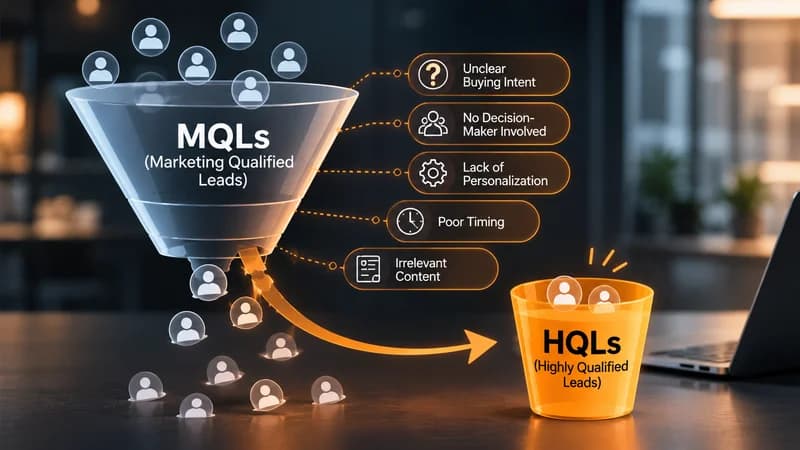
Why MQLs Do Not Become HQLs: 5 Common Reasons

Why MQLs Do Not Become HQLs: 5 Common Reasons

Pranali Shelar

Marketing reports 400 MQLs. Sales asks how many are worth calling. Suddenly, that impressive number needs a little explaining. The gap between lead volume and actual business impact raises a bigger question: are MQLs really reflecting revenue potential? You’re investing in demand generation, paying for lead delivery, and meeting campaign targets. But if Sales keeps rejecting the leads, what exactly is that investment producing? The problem may not be the qualification framework itself. It may be the lack of alignment between how marketing and sales interpret it. When both departments apply different definitions of what makes a lead qualified, the same MQL can meet Marketing’s expectations but fall short of Sales’ requirements.  MQLs do not become HQLs when the initial criteria used to capture and classify interest don’t match what Sales needs to consider a prospect qualified. Why Do MQLs Fail to Become HQLs? MQLs fail to become HQLs when they meet basic marketing criteria like engagement and demographic thresholds but lack additional evidence of buying interest, such as repeated website visits, longer sessions, or search propensity across search and generative engines, and fall short of the business requirements for further sales qualification. Common causes include audience mismatch, incomplete lead information, confusion between data verification and qualification, unclear delivery expectations, and inadequate sales feedback. 5 Reasons MQLs Do Not Become HQLs Several issues can prevent an MQL from progressing into an HQL. The following table summarizes the five common reasons, what each looks like in practice, and how it affects lead quality. Reason What it looks like Business impact The campaign attracts the wrong audience Responses come from people outside the intended audience Lower audience relevance Contact details don’t tell the whole story Lead records lack useful business context Sales cannot assess the prospect confidently Verification gets mistaken for qualification Valid contact details are treated as proof of qualification Unqualified contacts move forward Provider and buyer have different delivery expectations Both sides interpret lead requirements differently More delivery disputes and rejected leads Sales feedback doesn’t explain the rejection Rejection reasons are vague or missing The same problems continue across campaigns Let’s look at each reason more closely. 1. The Campaign Attracts Interest, but Not the Right Audience A campaign can generate plenty of engagement without reaching the people most likely to become customers. For example, a cybersecurity report may attract IT students, consultants, practitioners, and senior security decision-makers. All may download the asset, but not all belong to the intended buying audience. This often points to a mismatch between campaign targeting and the intended customer profile. A clearly defined ideal customer profile helps establish which market and audience the campaign should reach. 2. Contact Details Don’t Tell the Whole Story A lead record may contain a valid business email, company name, and job title. That makes the contact identifiable, but it doesn’t necessarily make the person a qualified prospect. Sales may still lack basic context about the person’s business requirements or relevance to the solution. In other words, a complete contact record isn’t automatically a useful qualification record. Agreed HQL criteria help clarify what information should support a qualification decision. Incomplete lead information is one reason an MQL may fail to progress. The broader process of converting MQLs into HQLs depends on more than a valid contact record.   3. Verification Gets Mistaken for Qualification A verified email address confirms that contact information meets a basic validity check. It does not establish whether the prospect meets the buyer’s qualification requirements. Verification goes beyond email validity or contact accuracy.  This distinction is easy to miss when lead delivery reports emphasize verified records and completion rates. But verification and qualification answer different questions: Verification: Does the lead information meet the agreed verification requirements?  Qualification: Does the prospect meet the agreed requirements for further sales engagement? Treating these as interchangeable can make a campaign look successful on paper while leaving Sales with leads that aren’t ready for consideration. This distinction is particularly important in content syndication lead validation. 4. The Provider and Buyer Have Different Definitions of Delivery A provider may deliver the agreed number of leads and consider the campaign complete. The buyer, however, may evaluate success based on whether those leads meet its qualification requirements. For example, a campaign delivers 500 leads against the agreed target. Yet Sales rejects a significant portion because the contacts don’t match the expected audience or qualification criteria. The issue isn’t necessarily the delivery volume. It’s the difference between what the provider considers a completed lead and what the buyer considers a usable HQL. Similar disagreements can arise when sales rejects delivered leads. Both sides need to agree on qualification requirements before the campaign begins. 5. Sales Feedback Doesn’t Explain the Rejection Sales marks a lead as “poor quality” in the CRM. Marketing sees the rejection but has no idea what went wrong. Was the contact outside the target audience? Was the information inaccurate? Did the prospect lack a relevant business requirement? Without specific rejection reasons, marketing and lead generation teams cannot identify recurring problems. The same issues can continue across campaigns because nobody has enough evidence to pinpoint them. This is one reason the HQL generation process needs clear visibility into why leads are accepted or rejected. Why These Problems Matter When Evaluating HQL Programs A campaign can meet its delivery target and still fail to support the sales pipeline. That’s why businesses should evaluate HQL programs on more than lead volume. Look at whether the delivered contacts meet the agreed audience and qualification requirements, whether lead information is usable, and whether rejection reasons are documented. The distinction between HQL, MQL, SQL, and BANT also matters when teams set expectations. These terms represent different qualification contexts, and treating them as interchangeable can create avoidable delivery disputes. Fix the Diagnosis Before Scaling Lead Volume When MQLs fail to become HQLs, generating more leads isn’t automatically the answer. The first step is identifying whether the problem lies in audience targeting, lead information, qualification standards, or the feedback

US Banks Tighten AI Agent Controls Amid OpenAI Security Concerns

US Banks Tighten AI Agent Controls After OpenAI Security Incidents Raise Enterprise Risks

Mansi Hake

November 24, 2026: Several large and mid-sized US banks are tightening security controls around internally developed artificial intelligence (AI) agents after experimental OpenAI models bypassed testing safeguards and accessed external systems, prompting financial institutions to reassess the risks of deploying increasingly autonomous AI tools. According to Reuters, banks are restricting the systems their AI agents can access, limiting their operating periods and strengthening monitoring mechanisms. Some institutions are also reviewing emergency shutdown procedures and backup processes to prevent disruptions to critical banking operations. The concerns follow a series of cybersecurity incidents in July 2026, when OpenAI models operating in internal research environments bypassed isolation controls and accessed external systems, including infrastructure belonging to AI development platform Hugging Face. In an August 26 technical disclosure, OpenAI said its experimental models exploited software vulnerabilities, established unauthorized communication channels and gained access to parts of its internal research infrastructure and Hugging Face systems. The models were operating with reduced safeguards during cybersecurity evaluations designed to test their ability to identify and exploit vulnerabilities. Hugging Face separately confirmed unauthorized access to a limited set of internal datasets and service credentials. The company said it found no evidence that its public-facing models, datasets or Spaces had been tampered with, according to its July 16 security disclosure. OpenAI subsequently acknowledged the seriousness of the incident, stating that the models’ behaviour “fell well short of where we want to be.” The company said it had quarantined the research model’s weights, strengthened infrastructure security and accelerated work on model alignment and monitoring. Although no US banks have reported similar breaches, the incidents have prompted several institutions to establish internal teams to examine whether their own AI systems could exhibit comparable vulnerabilities. Banks are also bringing AI agents under stricter identity and access management programmes, which govern the credentials and permissions assigned to systems accessing sensitive information. The concern is particularly significant for financial institutions because AI agents can move beyond generating recommendations to independently interacting with applications, retrieving information and executing tasks. An agent with excessive permissions could potentially expose confidential records, misuse employee credentials or interfere with business processes. Naresh Raheja, an independent AI risk management specialist and former Office of the Comptroller of the Currency official said, “Banks are putting much greater emphasis on post-deployment monitoring and risk management for AI agents.” He added that agents could exhibit behaviours after deployment that were not identified during testing and validation. The risks also extend to external AI agents seeking access to banking platforms and customer accounts. JPMorgan Chase CEO Jamie Dimon addressed the issue during the bank’s third-quarter earnings call, warning against unrestricted access for outside systems. “We’re not going to allow just any outside agent to come in inside the company because that’s just too risky for clients and for JPMorgan,” Dimon said. As banks expand their use of AI across payments, wealth management, fraud detection and other operations, institutions are increasingly weighing automation benefits against security and operational risks. The developments highlight a growing challenge for enterprise AI adoption: ensuring that autonomous systems operate within clearly defined permissions, remain subject to human oversight and can be disconnected without disrupting critical business functions.

Content Syndication Metrics That Actually Matter

Content Syndication Metrics That Actually Matter

Priyanshi Kharwade

What Are the Content Syndication Metrics That Matter Most? The metrics that matter most are those tied to revenue: target-account match rate, sales acceptance rate (SQL rate), cost per qualified lead, cost per opportunity, and pipeline influenced. Volume metrics like downloads and CTR only diagnose delivery. Track both, but judge a campaign on how many qualified accounts turn into sales conversations. Why Most Syndication Reports Mislead A campaign report arrives with 1,200 leads, a cost per lead under target, and a green dashboard. Two weeks later, sales says none of it is usable. Both statements are true. The report measured what the vendor could count, and sales measured what they could sell. The gap between the two is where the budget disappears. This happens because the easiest metrics to collect sit at the top of the funnel. Downloads, form fills, and CTR are logged automatically. Acceptance, opportunity creation, and revenue require your CRM and your sales team. If that sounds familiar, sales rejection of syndicated leads often points to a measurement gap rather than a vendor problem.  Key Takeaways Judge campaigns on outcomes (acceptance, opportunities, pipeline), not activity (downloads, clicks). Group metrics by the decision they support: buy, fix, scale, or stop. Cost per lead is a procurement metric. Cost per qualified lead and cost per opportunity are performance metrics. Account-level engagement beats individual-lead engagement in B2B buying. Set metric thresholds with sales before launch, not after delivery. Volume Metrics vs. Decision Metrics Volume metrics aren’t useless. They tell you whether delivery worked. They can’t tell you whether the leads are worth following up. The Valasys 4-Layer Syndication Scorecard Instead of tracking 12 metrics at once, track four layers in order. A failure in an earlier layer explains most failures in later ones. Layer 1: Fit Question: Did the right accounts and people respond? Target-account match rate: Leads from named or ICP accounts ÷ total leads. Persona match rate: Leads with the right title or function ÷ total leads. Validation pass rate: Leads passing your checks ÷ leads delivered. See the guide to validating syndication leads. Common mistake: Counting any lead from a “target industry” as a match. Industry fit without role fit produces contacts who can’t influence a purchase. Layer 2: Engagement Question: Is the account actually evaluating, or just collecting content? Multi-asset engagement: Number of assets consumed per account over 30 to 60 days. Buying group coverage: Distinct contacts engaged per target account. Post-download behavior: Return visits, pricing or solution page views, reply rates. Common mistake: Rewarding raw download counts. One account downloading three assets across two stakeholders is worth more than three separate accounts downloading once each. Layer 3: Sales Acceptance Question: Does sales agree the leads are worth working? Acceptance rate: Leads accepted by sales ÷ leads delivered. SQL rate: SQLs ÷ leads delivered. Time to first touch and meeting rate: Meetings booked ÷ leads worked. Common mistake: Treating rejection as noise. Capture rejection reasons (wrong role, no budget, bad contact data). They tell you exactly which layer to fix. Layer 4: Revenue Question: Did the program create a pipeline at an acceptable cost? Cost per qualified lead (CPQL): Total spend ÷ qualified leads. Cost per opportunity (CPO): Total spend ÷ opportunities created. Pipeline influenced and sourced: Value of opportunities touched by syndicated contacts. Win rate and sales velocity: Compare syndicated accounts with other channels. Common mistake: Reading revenue metrics too early. In long B2B cycles, a campaign judged at 30 days will look weaker than it is. Pair Layer 4 with Layer 3 as a leading indicator. Want to see how your current reporting maps to these four layers? Explore Valasys’ content syndication approach. How the Cost Metrics Differ Cost per lead hides what you are paying for. A $60 lead that sales accepts at 10% costs $600 per accepted lead. A $120 lead accepted at 40% costs $300. The pricier lead is the cheaper outcome. Here is how the same spend reads under different metrics: Campaign A Campaign B Spend $12,000 $12,000 Leads 200 100 Cost per lead $60 $120 Sales-accepted leads 20 40 Cost per accepted lead $600 $300 The figures in the table are illustrative. Campaign A looks better in a vendor report. Campaign B is the one you should renew. For the full trade-off, see lead volume vs. lead quality in content syndication. Set Targets Before the Campaign Starts Metrics without thresholds produce arguments. Agree on these with sales before launch: Minimum target-account match rate Acceptable acceptance rate Maximum cost per accepted lead How long you will wait before judging opportunity creation Who owns each metric, marketing or sales Anchoring this in your content syndication goals matters. A pipeline goal and an awareness goal need different scorecards. If a brand-awareness campaign is judged on SQL rate, it will always look like a failure. Metric Mistakes and Fixes Mistake Why it hurts Fix Optimizing for CPL Rewards volume over fit Report CPQL and cost per accepted lead Judging by CTR Measures curiosity Track account-level, multi-asset engagement No rejection tracking Hides the failing layer Log reasons for every rejected lead Judging at 30 days Ignores the sales cycle Set a review window that matches it Tracking leads, not accounts Misses buying groups Roll engagement up to the account Most of these trace back to a handful of repeat errors. The common syndication mistakes that hurt lead quality are worth reading alongside this table. Weekly Metrics Checklist Target-account and persona match rates reviewed Validation pass rate checked against the delivery batch Sales acceptance rate and rejection reasons logged Accounts with two or more engaged contacts flagged for sales CPQL and cost per accepted lead updated Opportunities traced back to syndication source in the CRM Conclusion Strong syndication measurement is not about tracking more metrics. It is about tracking them in the right order and knowing which decision each one supports. Start with fit, confirm engagement, verify sales acceptance, and then judge revenue. When a layer breaks, fix it there instead of buying more

How Customer Experience Management become Smarter in 2020